

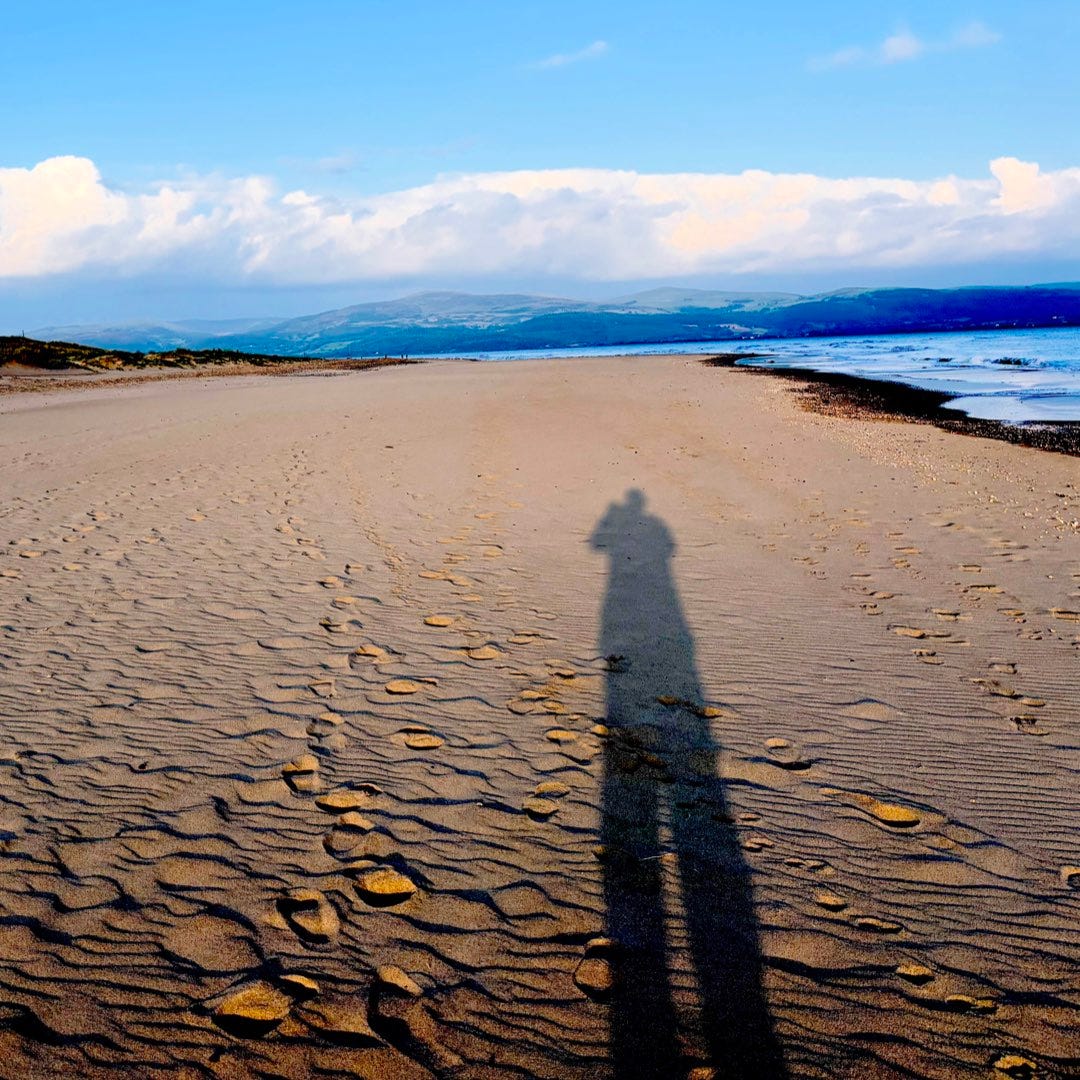
I’ve always wanted to be outside more than inside. As a child, I loved the woods: Saturday morning adventures with my friends, and midnight quests alone.
A few times in my early teens, while my mother and sister slept, I snuck out and walked the two miles to my school. Beyond the playing fields, I’d find the darkest place and sit there, hidden by the night. The most terrifying part was walking home through the council estate where I lived. At 3am, Queens Park could be a messy place, especially on weekends.
As a young adult, I was still keen to be out in the hills and mountains. I’ve walked for miles in heavy boots, trainers, even sandals, sometimes bivvying on bare moorland or in rainforest ravines in north-west Wales.
Now I’m an adventurous dog-walker, taking forestry tracks as far as they’ll go and following beaches to their natural nowhere. When I’m out, I’ll sometimes find a scrap of lyric, a mad idea for a sci-fi novel, or an unforeseen way into whatever I’m researching that day.
And when I’m not distracted by my own meandering, I’ll sometimes find myself in the ‘thinking’ of the place. The long-worked Welsh landscape seems to have its own ideas. Its thoughts feel long and cyclical; recurring, uncomplicated, inevitable. Some are of life rising and striding on; others of seed sinking into the ground that will reclaim us all. Another is of one body, pregnant with the whole cycle.
And I’m not the only one to hear these musings in the mountains. The Welsh tale of Gwion Bach tells of this turning. Young Gwion steals a taste from Ceridwen’s cauldron, a brew promising pure awen. He is drenched in cosmic knowledge, and knows with terrible certainty that the sorceress will be having his thieving guts for garters.
Touched by the divine, he finds the ancient power of transformation, the ultimate imagination. Through it he flees Ceridwen’s wrath by changing into swift-leaping, fast-finned, light-winged prey, each time escaping her jaws by a hair’s breadth. But she runs him down and finally eats him, he a grain of golden wheat, she a monstrous black hen.
Gwion is consumed until only a speck remains. Having taken his life into herself, the old witch conceives, and nine months later gives birth to a radiant infant, already the greatest bard of the West. After flight, death, and mysterious rebirth—now named Taliesin—the infant remembers the great cycle of manifest nature.
I think of this myth as I walk the seasons at home. I’m drawn out into the world, pulled into the qualities of this life: close loves, and the worn ends of connections remembered but long lost. When I have the courage to meet this brief existence, to join freely in the tumbling forward of it all, I find a goodness out there, a nourishment.
Foolish, I know. In the same breath I sense my own coin spinning in its entropic arc. On empty hillsides where there are no lies, I hunt for the blessed deer, and know I also flee with her. I can’t make more sense of it than that, I’m afraid. There’s just no reasoning with old Ceridwen.